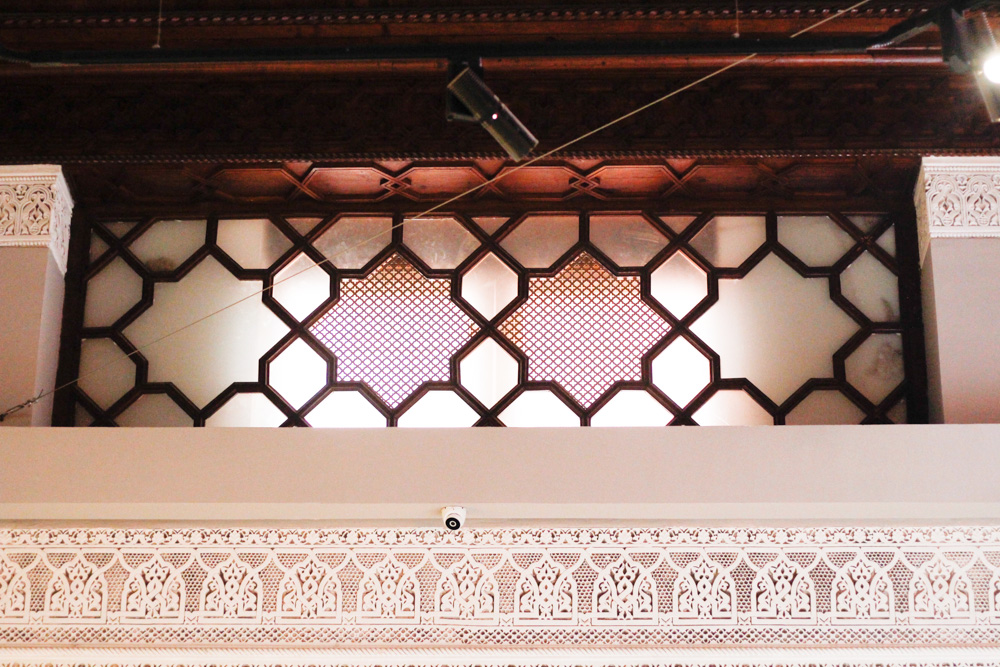
Day336: Rabat “The Geometry of Latticework”
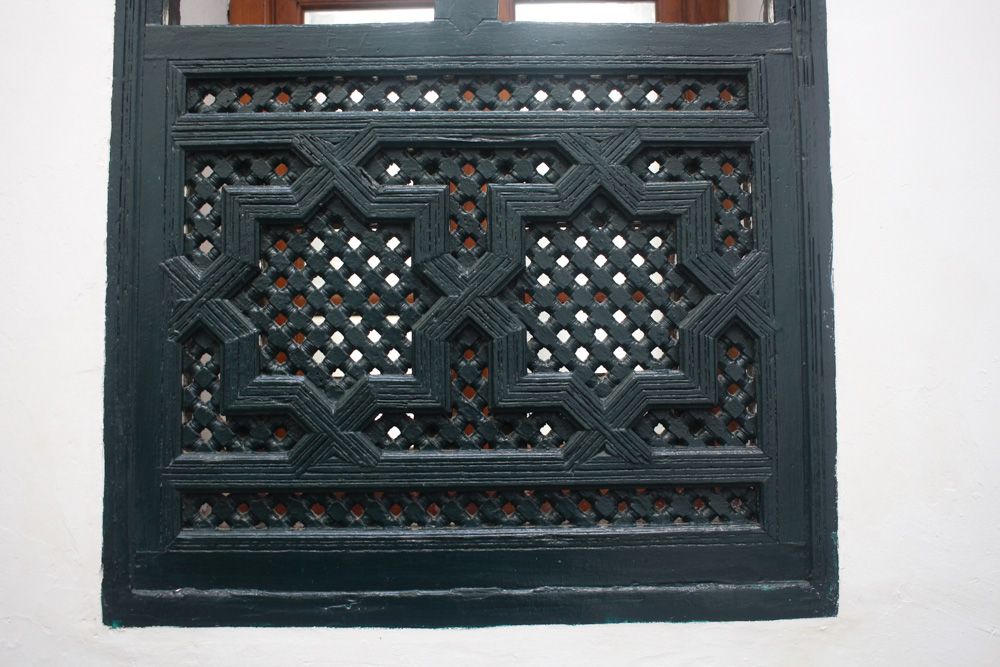
A lattice window formed by interlocking minute wooden components one by one, entirely without nails, is known as a mashrabiya.
It is a precise craft that shares a common spirit with Japanese kumiko woodwork. The ones I observed were exclusively star-shaped patterns, so I was unable to capture other variations. However, the intricate details—where lines intersect and radiate from the center to expand infinitely—were far more complex than their Japanese counterparts, to the extent that I could not immediately grasp the underlying structure of the craftsmanship.
This is because, while the Japanese kumiko I envisioned involves processing and interlocking long, continuous pieces of wood, this structure apparently separates the joints from the connecting rods entirely. The ends of the rods are inserted one by one into the holes of tiny joint pieces to assemble the star patterns, and finally, the entire piece is fitted into a sturdy outer frame and tightly compressed from all sides, forming a single, rigid panel without the use of any adhesive.
細かな木片を一本ずつ、釘を一切使わずに噛み合わせて組み上げる格子窓をマシュラビーヤと呼ぶ。
日本の組子細工にも通じる精緻な手仕事だ。私が見たのは星形のパターンのものばかりで他のバリエーションまで拾えなかったのだが、中心から放射状にラインが交差して無限に広がっていく細工は日本のものより複雑で、どういう細工になっているのか理解がすぐにできなかった。
というのも、私が連想した日本の組子が一本の長い木を互いに加工して組んでいるのに対し、これはジョイントと棒のパーツが完全に分かれているらしい。小さなジョイントの穴に棒の端を一本ずつ差し込んで星型に組み上げ、最後に全体を頑丈な外枠にはめ込んで四方からギチギチに締め付けることで、接着剤なしでひとつの強固なパネルになっている。